
 Posted by
 Thanks to Ben Raymond from Science Untangled for reviewing a draft of this and clarifying the statistics terms. The listen, as always, is you should use Science Untangled apps for all the analysis.
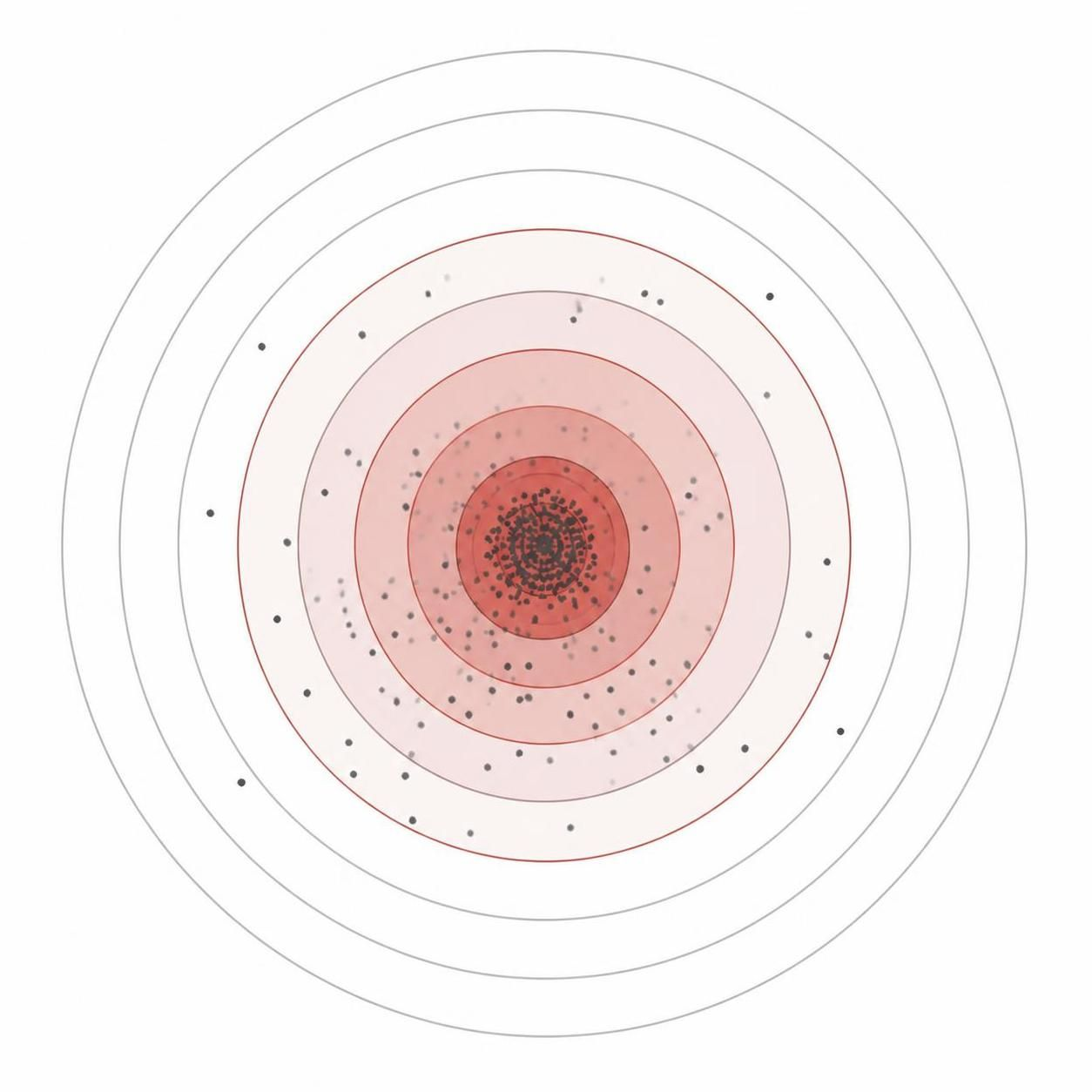
It is a common training tool to use targets for various skills. In volleyball there are many examples. A basket for setters, a basket for receivers, a mat on the floor for servers or spikers are the obvious ones that spring immediately to mind. If the players’ goal is to hit the centre of the target, the logical expectation, the actual distribution of attempts1 will look something like the following diagram, with the most attempts clustered around the centre of the target and the remaining attempts distributed further away, in a 2D Gaussian distribution2.
When players are using a target, in many cases their distribution of attempts is not around the centre of the target. For example, I once used a drill to encourage spikers to spike high over the net and deep, but making the last metre of the court the target zone. The scoring system judged equally attempts that were out beyond the baseline and attempts that were in front of the line, but still in the court. Player A spiked a lot balls in front of the line, spikes that were errors in this drill, some just over the line, and none close to the baseline. Another drill I have used was a high ball setting drill with a basket as a target. Players got very few balls into the basket with most sets being away from the net. The lesson, as always, is that we should not assume that players’ motivations are the same as the ones we expect of them. A couple of other musings on that topic are here and here.
If we accept that attempts will cluster around the centre of the intended target, and we recognise that players do not always have the same motivations that coaches want them to have, we can work in reverse. By noticing where the centre of the cluster actually is, we can understand the underlying motivations of the players. More specifically in volleyball, we can understand the types of errors that are acceptable to them. In the case of Player A, the worst error for him to make was to spike too long. In real life he was able to ‘accept’ being blocked, or spiking wide, but could not accept spiking long. With that knowledge, the approach to teaching and feedback could be adjusted. In the case of the high ball setting, the apparently unacceptable error for the players was to set too close to the net. In this case, an explanation that sets close to the net are not errors, and often gave the attacker different and more effective attack solutions, e.g. recycling, or tooling the block, makes a big difference. In both cases pointed out the observation can by itself make a difference by highlighting the players’ internal and perhaps unconscious preferences.
Watching carefully what players actually do, can give important insights into how they see the game and their role within it, and importantly help the coach help them.
- Assuming everything else is equal, which it is not, but is a reasonable assumption for the situation. ↩︎
- Assuming I have corrected understood my brief excursion into to AI to find the background information for this. As with the previous footnote, if I am slightly incorrect with my terms and understandings, it does not affect the central premise of my observation. ↩︎

