
 Posted by
 The following was originally published in the Australian Volleyball Journal, Volume 4, Issue 1, March 1976. More on the early days of the Australian volleyball team in the 1970s.
Joe Hiller Retires
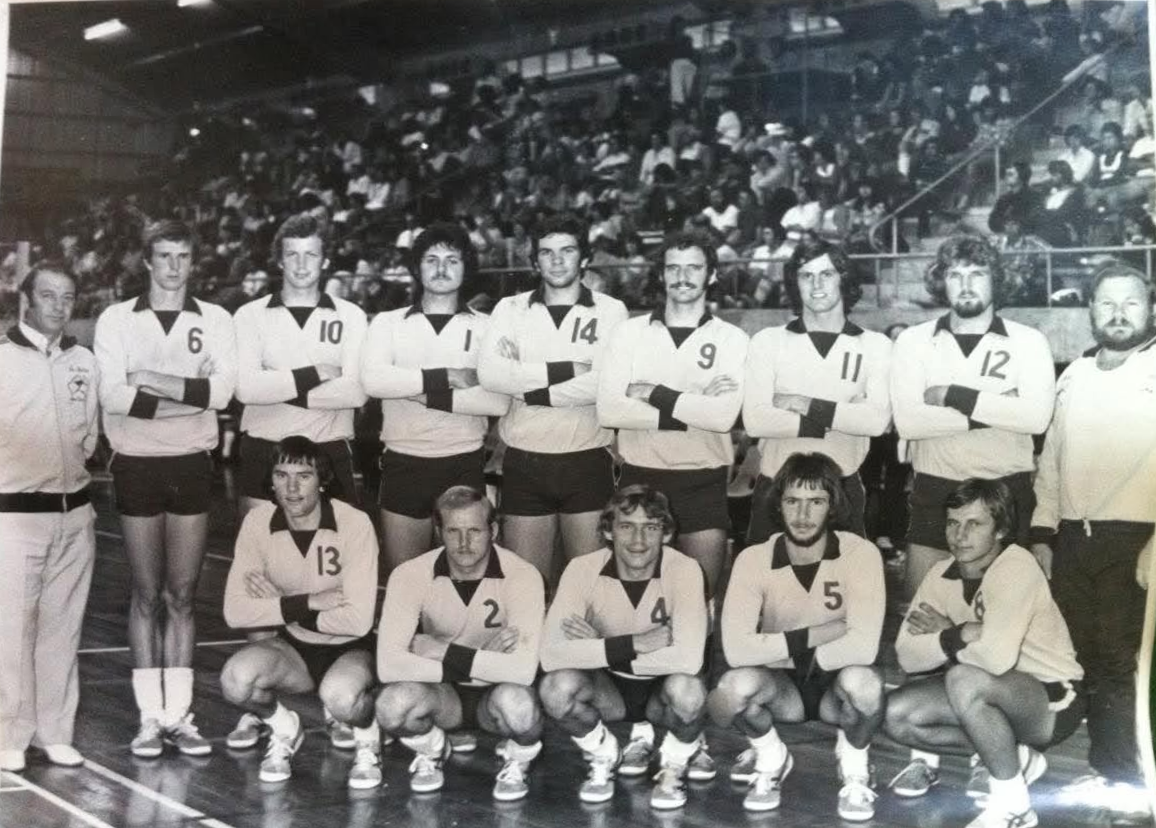
Joseph Hiller, one of the outstanding motivators of Australian volleyball development over the past decade, has retired. For many volleyball followers across the country it will be difficult to comprehend that Joe will no longer appear on the coach’s bench for Victorian and Australian teams, scheming patters of play which would overcome the opposition, exhorting his teams to a final supreme effort or having a quiet beer with his friends once the battles for volleyball supremacy have ebbed. During an outstanding career spanning eleven years, as coach of Australia’s premier men’s volleyball State Joe has contributed a tremendous amount of time, energy and money to the sport which for many years was his prime factor in life to the detriment of other considerations. He has known the sweet taste of success as well as bitterness of defeat, which after all is an essential ingredient in any field of human endeavour.
Taking over coaching duties of the Victorian State team in 1968 he scored a first up success, breaking the title hegemony held by New South Wales during the previous four years. Then came years of team building and bitter disappointments. Some of the most brilliant and talented teams Victoria has produced foundered in the holocaust of the nerve-wracking annual event, known as the Volleyball Championships of Australia. The inevitable day of reckoning came in 1972 in Sydney when the Victorians under Joe’s tutelage regained the title by a narrow margin despite a defeat against New South Wales. This has remained their last defeat to date[1].
During this decade Joe coached and guided many outstanding Victorian and Australian players, among them Les Maklary, Ilke Veijalainen, ‘Ozzie’ Ozolins, Nick Kimoff, Hans Siig, George Mraz, Stewart Uher, Jack Atkins and last but not least his own son John.
With his wife Celina, who has supported him over the years, Joe has settled into a new home in the Melbourne suburb of East Oakleigh, to lead a full social life, plan a return trip to his homeland Poland, later in the year and perhaps still follow Australia’s and Victoria’s volleyball fortunes on occasions.
The ‘Volleyball Journal’ is proud to present an interview conducted by George Mraz and wish Joe all the best in the future.
Volleyball Journal Interview – George Mraz talks to Joe Hiller
V.J. How was your interest in volleyball generated and at what level did you play?
J.H. Actually, volleyball was my number three sport. I had 32 bouts as an amateur boxer and played soccer on a regular basis. Whilst in the army for for two and a half years, my interest became more intense. After completing a Physical Education course in Warsaw, I began coaching a second league club in 1955. Incidentally, we played and beat a Chinese National U23 team during that time. I coached and played until my arrival in Australia in 1960.
V.J. What was the structure of volleyball organisation in Poland?
J.H. The Polish National Volleyball Association had numerous levels of competition –
– First League 12 teams
– Second League 24 teams
– Third League 24 teams
– A,B,C & D Divisions
Junior
– Technical Schools
– Teachers Colleges
– High Schools
The National Team was based at the Academy of Physical Education
V.J. How and when did you get involved in volleyball in Australia?
J.H. On my arrival in 1961, I contacted a Melbourne Polish Club. They played a very old system, with the setter on the front Line always switching to number three position. Spikers had a tendency of jumping off one Leg. My new ideas from Poland were not accepted and I dropped out of volleyball altogether for 4 years. Then in 1964, out of the blue, I was approached to coach Lechia. I only fasted one year; their poor attitude to training, games and discipline were not to my liking.
In the period 1965 to my retirement in 1979, 1 was player/coach for the following club teams – Graduates, R.S.C. and Wallabies.
V.J. When did you commence coaching State and National teams?
J.H. From 1968 to 1978 I was coach of the Victorian Men’s Team, winning the National Championships in 1968 and from 1972 to 1978 inclusive.
I was appointed Assistant Coach of the ill-fated Ceylon trip in 1969 and the following year as National Coach until 1977.
V.J. What are your most memorable experiences?
J.H. Various overseas fours with the National side – Tahiti 1971; China 1975 – most memorable of all – I would never in my wildest dreams have thought I would even have a chance of visiting this country, especially prior to it being open to the general public. We gained a lot of experience, not only in volleyball, but the people and sites. The feeling of playing before a crowd of 19,000 in Peking was unbelievable.
– Attendance at an International Referees Course in Kuala Lumpa in 1969.
– Oceania Championships, Sydney 1973 and Nelson, N.Z. 1976.
– International competition matches against a top Japanese Club Team Asahi Kasai in 1974 and top French Club Team ‘Racing Club De France’ in 1974.
– The Asian Championships in 1975 where the Australian men finished a creditable fourth behind the top ranking teams of Japan, Korea and China.
– Maintaining Victoria ass the dominant force in Australian volleyball in the past decade.
V.J. What would you consider to be your main contribution to Australian volleyball? \
J.H. I gave a lot of years to the sport I love with minimal support from the administration on state and National Levels. I gave my experience and knowledge gained overseas to my club, state and national players.
Coached the Australian Team for a decade in all its international games, climaxing with a fourth placing at the Asian Championships 1975.
Gained respect for the National Team as being a force worthy of playing in international competition.
Instilled pride within players with the knowledge that they could compete against any opposition.
V.J. What kept you involved for so long at top coaching level?
J.H. Mostly the challenge, but also the chance of bringing up younger players and of course, meeting old friends at championships. Travel was always a factor – I have been to all capital cities in Australia with volleyball teams. My dream was to make Australia a force in international volleyball.
V.J. Any regrets?
J.H. Disappointed after the Asian Championships in 1975 that there was no worthwhile international competition within Australia.
The lack of competent organisational abilities at State and Australian administration to make the sport of volleyball grow and improve faster than it has.
The Lack of top-class facilities.
Insufficient money to promote the sport. Players and Coaches have to finance their own training, registration dues, playing uniforms, competitions, local and overseas travel etc. etc.
V.J. From your first to last experiences as coach of top level teams, what changes have taken place?
J.H. (a) Play within Australia –
Player system changes – front setter always changed into centre front position. Now, setter runs in from the back using Czech or Russian systems. The game now is much faster and more skilled. “Dummie” patterns seem to be the norm, this demands better technique, tactics and a much fitter and capable player.
(b) Administration –
It appears that the administration has improved and become more stable. Contact with overseas countries is greater, especially after the Asian Championhips. There is more literature and films available on volleyball.
The establishment of Coaches and Referees Commissions was a step in the right direction.
State and A.V.F. bodies seem to co-operate much more with each other than before.
(c) World Sphere –
When I attended the Munich Olympic Games in 1972 as an Official Congress Member, I did not expect the Cuban Men and Women to be the force that they are today (their example could be copied to some extent by Australia).
The Japanese decline and the resurgence of Poland as a power to be reckoned with.
V.J. What does the future hold for a) Australian volleyball b) for Joe Hiller?
J.H. Australian volleyball – I am afraid that if we continue in the same way as we have recently, the standard of play will not improve, but may even drop. Urgent need for international matches, especially within Australia.
Joe Hiller – Mainly to concentrate on refereeing and part-time coaching of lower standard teams.
At this point of time I would Like to thank all the players that I have been associated with for their understanding and support that they have given me through the years as coach and friend.
[1] Written in 1979.

