
 Posted by
 I knew I had written some stuff about high balls, but I didn’t know I had written so much that there was a tag for it. Click here it is if you want to check them all out. If not, here is the Cliff Notes version of my various thoughts. For a long time, managing high balls has been one of, if not the preeminant requirement for success in high level men’s volleyball. Initially, most high balls were attacked after defence, so high balls were important for scoring points in the sideout era. As the rally point era has evolved and serving has become stronger (and reception weaker) high balls have also become important in the sideout phase. One of the more recent developments has been the focus on setting high balls primarily (in some cases only) to position 4. Following the law of unintended consequences this has had the effect of reducing the impact of the opposite (who (no longer) attacks in position 2 and 1) and the libero (who is naturally facing position 2/1). So what you see a lot is outside hitters running around taking a lot of balls they are not in position for, and forcing the ball to position 4 even if a) it is the most difficult set, and b) it results in a bad set. The contortions that players get into in order to follow those instructions are often quite comical. The argument is that attack efficiency (the first thing you have to say to get me riled up. Start here or here for more.) shows position 4 is the best place from which to attack a high ball.
I ‘feel’ like this is wrong and wrote here about it. And even if it is partly right, it is not always right, which highlights a problem with analytics in sport in general. The answer is always, sometimes it is best to set a high ball to position 4, sometimes it is not. But that answer is not emotionally satisfying1. So I kept searching for some ‘proof’.
COACHING WEBINAR SPECIAL OFFER!!
If you don’t already know, I am a bit a lunatic. Over the years I have been collecting data on setter positions and attack directions (including direction and landing point) precisely input into Data Volley files. The data set includes 95 matches from a variety of leagues at the men’s professional level. The total number of attacks with setter and direction data is 15,517, of which high balls number 3,597. My hypothesis is that the position of the attack is not important by itself, but the position of the set determines the best position to attack. As always I turned to Science Untangled to do my analysis. In case you don’t know, the SU apps are amazing, easy to use, and ridiculously cheap. They are unquestionably the best. Digression aside, I include the actual data with heatmaps below for your perusal but here is the summary.
| POS 4 | POS 2 | POS 1 | ||||
| SET ORIGIN | K% | RWR% | K% | RWR% | K% | RWR% |
| LEFT | 30.4 | 56.8 | 23.6 | 49.7 | 25.6 | 42.9 |
| MIDDLE | 35.6 | 58.6 | 35.8 | 59.0 | 34.6 | 59.4 |
| RIGHT | 31.4 | 52.2 | 32.9 | 59.7 | 33.3 | 56.3 |
I have to admit that I was quite surprised by the results. Rarely are my hypotheses so neatly ‘proven’ by data.
– If you set from the left side of the court (the green box in the heatmaps below), position 4 is very clearly the best place to set.
– If you set from the middle of the court, i.e. every attack position is essentially equidistant from the setter, then all positions are essentially equiffective (is that a word?).
– If you set from the right side of the court, it is better to set to position 2 or 1.
– Extrapolating, a little but not much, the optimum distance for a high ball set to travel is 4 – 6 metres. Anything more or less than 4 – 6 metres and effectiveness decreases.
So there you have it. Let liberos set high balls to opposites.
TIPS AND PLANS FOR YOUR PRACTICE
Here is the raw data.
V5 = high ball in position 4
V6 = high ball in position 2
V8 = high ball in position 1
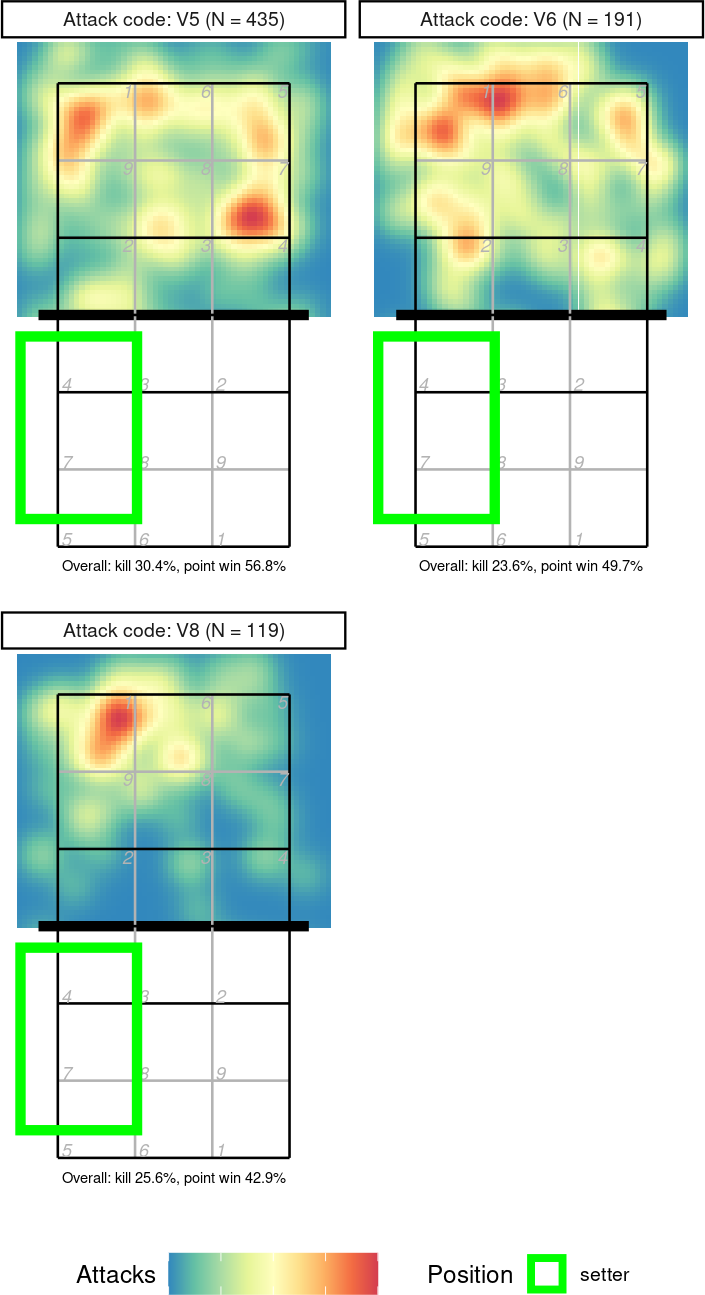
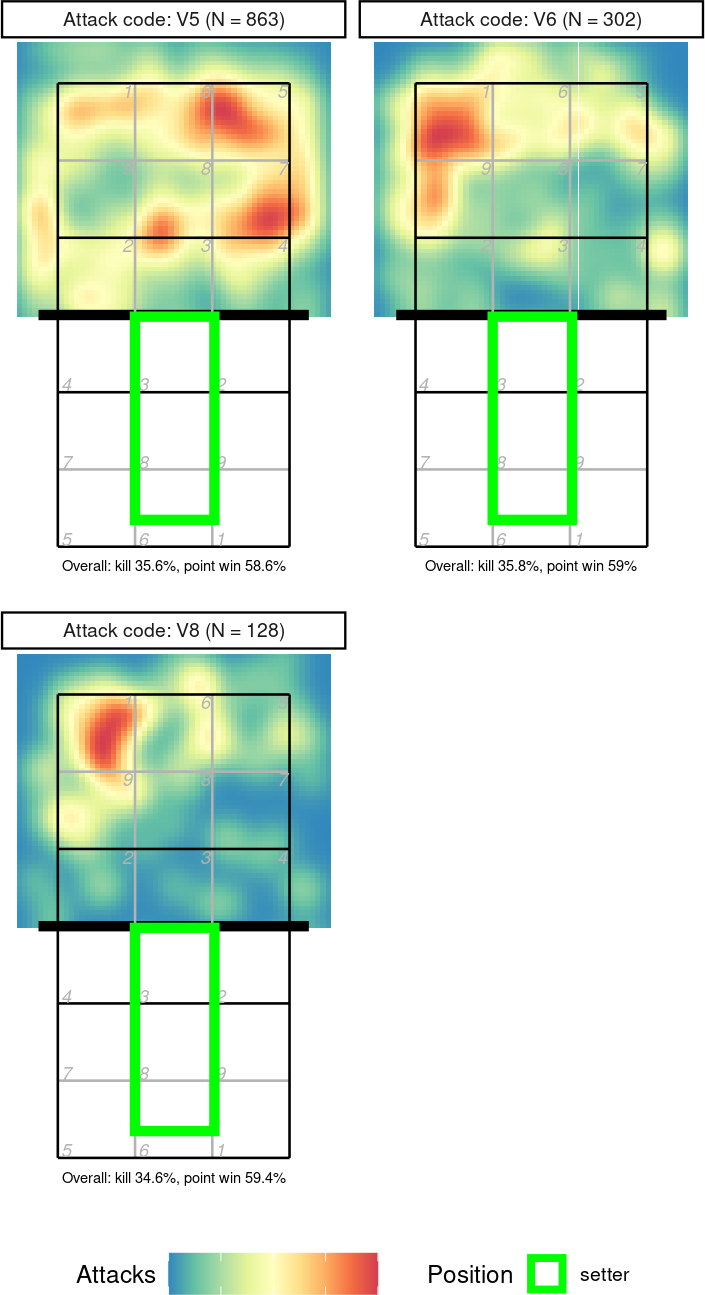
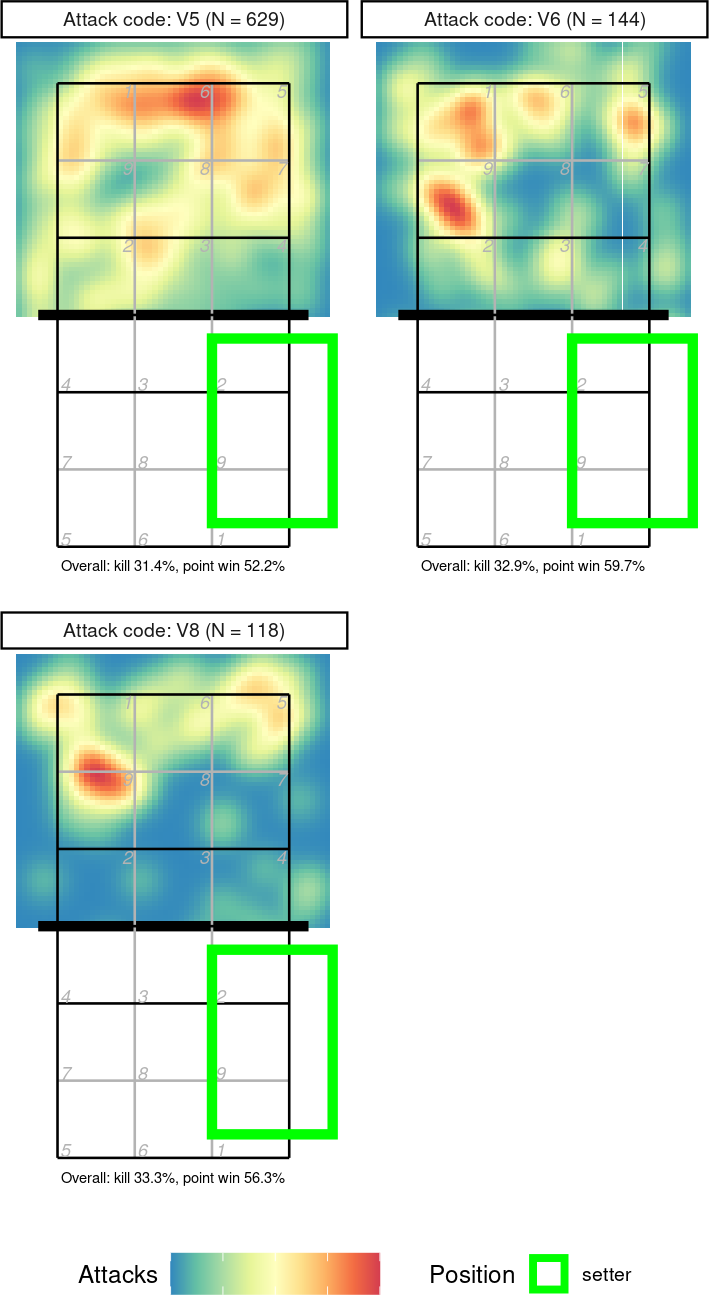
- I recently heard on the Press Box podcast a quote by Joel Anderson who said that conspiracy theories arise when the truth is not emotionally satisfying. If I were a lesser man, I would say that his explanation is emotionally satisfying. ↩︎
A collection of Coaching Tips can be found here.
 At Home On The Court
Does the data show a major difference between setting each position from near the net as opposed to from near the baseline? Seems like trying to attack the ball coming from directly behind you would be very difficult in position 1/2, 1 especially, if right handed.
LikeLike
The data showed closer is better. That is wherever the setter is on the court, the closer set was more effective than the longer.
The set from close to the net is more effective than far from the net, but we are talking about situations where you have no choice on the set origin but you do have an option on the set direction.
LikeLike