
 Posted by
 So the Olympics are finished. And what a tournament it was. Every day of competition it seemed like there was a classic match right up until semi final day. That the last two competition days were an anticlimax in comparison took nothing away from the overall tournament. I don’t know the exact reason, but somehow this tournament moved me in a completely different way than previous tournaments. I am sure the atmosphere in the stadium was part of it, there was also a different connection with the participants than I remember from before. Whatever it was, I enjoyed it immensely.
It was interesting to follow the tournament and note some differences in the game from just three years ago. The feeling was that the rallies were long and that all teams at different points went through periods in which it seemed almost impossible to score. That was the impression, at least. Luckily I have some actual data, and can investigate some of those feelings. In the first post in the series I went over some basic statistics and found that both sideout percentage and attack percentage were lower than the previous Olympics in Tokyo. I also noticed that were more service aces with the same error rate.
For this post I want to dig down a little bit to find out why the attack percentage is down. Here we go…
Is attack worse because offences are more conservative (i.e. setting less first tempo)?
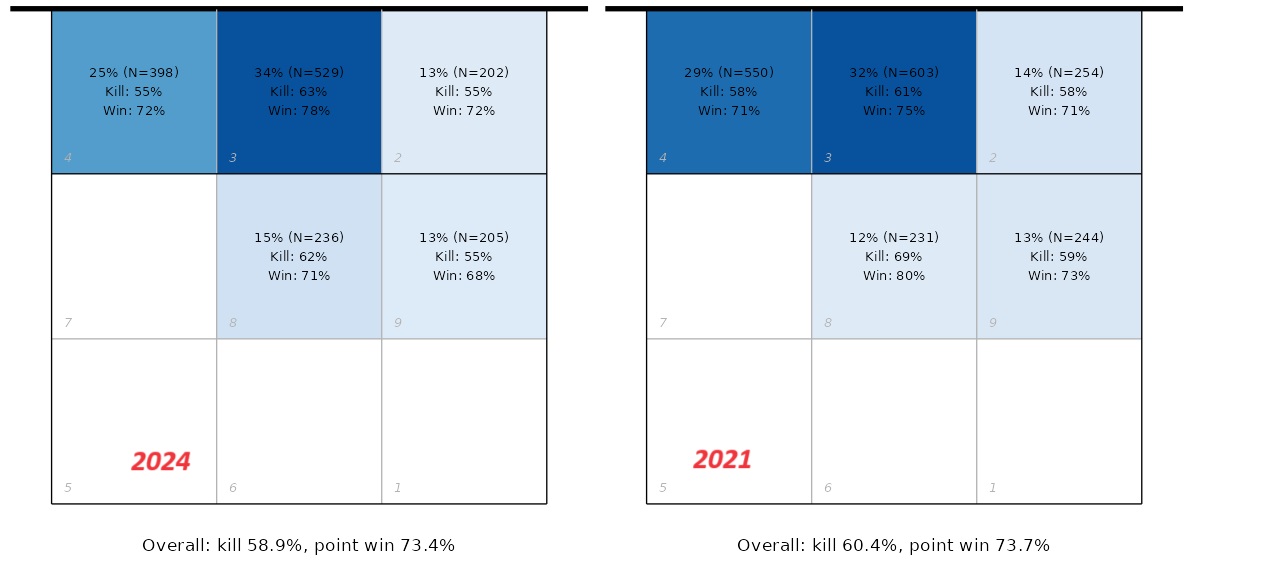
Above is the tournament distribution from good reception. In 2024, 49% through the middle of the court v 44% in 2021. We cannot say that offences are more conservative. First tempo was set more often, and with more effect. Position 2 and 4 scored less often directly but were overall effective in scoring points. Position 6 and 1 however were must less effective.
Is attack percentage lower because of a change in the mix of attack tempos? (i.e. do we see less fast balls and more balls)
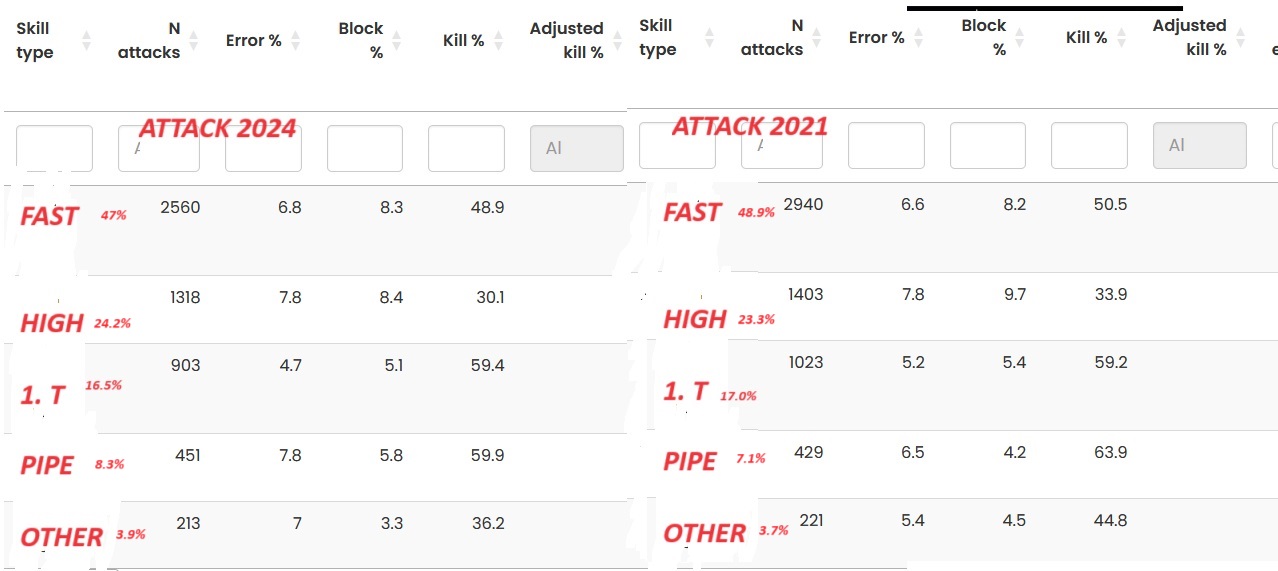
We do in fact see that there are fewer fast balls and more high balls than previously. But also more pipes, which theoretically should even things up. But we can also note that with the exception of first tempo, all attack is less effective than at the previous Games. So far it seems we can say that block and defence are better.
Less fast balls and more high balls suggests serving might be better. We saw previously that serving was with more aces and same amount of errors. Does that mean serving was stronger overall?
| 2024 | 2021 | ||
| % OF TOTAL | DIFFERENCE | % OF TOTAL | |
| PERFECT (#) | 9.3% | -3% | 12.3% |
| GOOD (+) | 33.5% | -0.2% | 33.7% |
| OK (!) | 22.7% | -0.1% | 22.9% |
| POOR (-) | 23.3% | +1.2% | 22.1% |
| OVERPASS (/) | 3.6% | = | 3.6% |
| ACE | 7.5% | +2.2% | 5.4% |
| TOTAL | 3683 | 4108 |
The overall quality of reception was indeed worse. Setter had to work with more than 3% fewer good passes.
If attack percentage is lower, then there should be more transition attacks, which would lower attack percentage even more.
| ATTACK PHASE | 2024 | 2021 | ||
| RECEPTION | 3329 | 59.3% | 3704 | 61.6% |
| TRANSITION | 2216 | 40.7% | 2312 | 38.4 |
| TOTAL | 5445 | 6016 |
After all that, what is our conclusion?
Attack percentage is lower because …
– serve is better
– block and defence is better
– lower attack percentage leads to more transition attack
– more transition attack lowers attack percentage
– we should always set more first tempo
If you have any specific questions about the Olympics that can / could be answered by analytics, by all means drop me a line.
 At Home On The Court
One comment